Roots Running Out of Room: How to Know When Your Plant Needs a Bigger Home
The Plant That's Doing Everything Right (And Still Looks Wrong)
You water it on schedule. You've got it in the right light. You even remembered to fertilize last month. And yet — your plant looks sad. Yellowing leaves, stunted new growth, soil that dries out within a day of watering. Before you start diagnosing pests or tweaking your fertilizer routine, flip that pot over and take a look at the drainage hole.
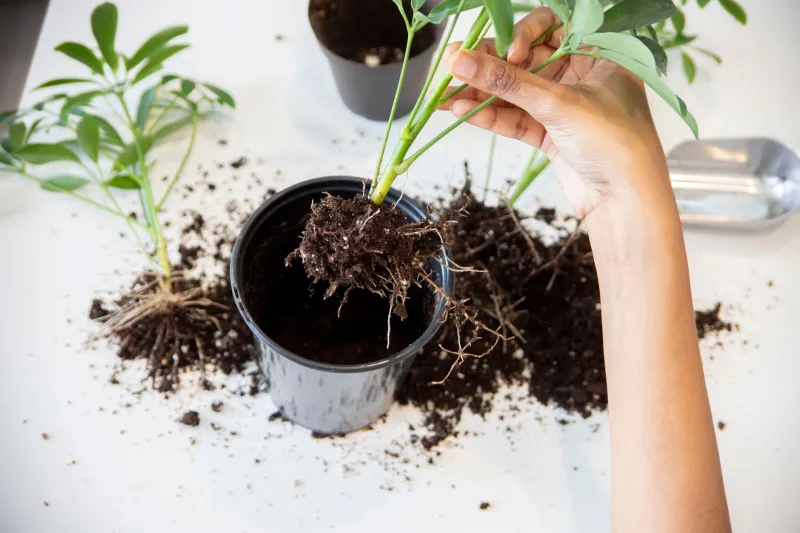
If you see a tangle of roots spiraling out the bottom, you've found your answer. Your plant hasn't outgrown your care — it's outgrown its container.
At Frankie's Nursery, we see this all the time. Gardeners come in convinced something is wrong with their plant, and nine times out of ten, all it needs is a little more room to breathe.
What "Root-Bound" Actually Means
A root-bound plant — sometimes called pot-bound — is one where the root system has grown to fill every available inch of its container. There's no loose soil left, no room for new roots to expand, and nowhere for water to go except straight through without being absorbed.
At that point, the plant is essentially fighting itself. The roots start circling the interior of the pot, sometimes wrapping so tightly they can girdle the plant over time. Growth slows. Water retention drops. The plant puts all its energy into survival rather than thriving.
The tricky part is that root-bound conditions don't always look dramatic right away. A plant can be seriously cramped for months before the visible symptoms become obvious — which is why knowing the timelines matters just as much as knowing the signs.
Signs It's Time to Size Up
Here's what to look for before things get critical:
Roots escaping the drainage hole. This is the most obvious tell. If roots are poking out the bottom or circling the surface of the soil, the plant is already past ready.
Soil drying out unusually fast. When roots take up most of the pot's volume, there's less soil to hold moisture. If you're watering every day or two and the pot still feels bone dry, that's a red flag.
The plant lifting itself out of the pot. Sounds dramatic, but it happens. A heavily root-bound plant can actually push itself upward as the root mass expands. If your plant looks like it's trying to escape, it is.
Stunted or stopped growth. A healthy plant in the right conditions should be putting out new leaves or stems regularly during its growing season. If yours has stalled out despite good care, cramped roots are often the culprit.
Cracked or misshapen containers. Plastic nursery pots can actually split under pressure from an aggressive root system. If your pot looks distorted, check inside immediately.
General Timelines: How Fast Do Plants Outgrow Their Pots?
Every plant grows at its own pace, but here are some practical benchmarks that can help you stay ahead of the problem:
Fast-growing tropicals like pothos, philodendrons, and monsteras typically need repotting every 12 to 18 months when actively growing. In ideal conditions — bright indirect light, warm temperatures, regular watering — they can fill a pot surprisingly fast.
Moderate growers like snake plants, ZZ plants, and rubber trees can often go two to three years between repottings. These plants are slower and tend to tolerate being slightly root-bound without too much drama.
Outdoor container plants — annuals, perennials in pots, dwarf shrubs — should be evaluated every spring before the growing season kicks in. If the plant spent the previous year looking cramped, don't wait to find out this year.
Seedlings and young starts grow the fastest relative to their container size. A tomato start can go from seed tray to four-inch pot to gallon container within just a few weeks in warm weather. Keep a close eye on anything you're actively growing from seed or a small cutting.
How Much Bigger Should You Go?
This is where a lot of gardeners make a well-meaning mistake: they go too big. It seems logical — give the plant room to grow! — but oversized containers can actually cause problems. Too much soil holds too much moisture relative to the root system, which creates conditions for root rot.
The general rule of thumb is to move up one pot size at a time. If your plant is currently in a 4-inch pot, go to a 6-inch. From a 6-inch, move to an 8-inch. For larger plants in gallon containers, adding two to three inches of diameter is usually plenty.
There are exceptions. If a plant is severely root-bound and has been neglected for a long time, it may benefit from skipping a size — but that's the exception, not the standard approach.
Timing Your Repot for Success
Spring is the sweet spot for most plants. As temperatures rise and day length increases, plants shift into active growth mode, which means they recover from the stress of repotting much more quickly than they would in fall or winter.
For tropical houseplants, the same principle applies. Repotting in late winter or early spring — just before new growth starts — gives the plant the best window to establish itself in its new container.
Avoid repotting when a plant is actively blooming, visibly stressed, or just brought home from the nursery. Give new plants a few weeks to acclimate before you start moving them around.
A Few Things Worth Knowing at the Nursery
When you're shopping for plants at Frankie's — or anywhere, really — it's worth checking the root situation before you buy. Gently tip a nursery pot and peek at the drainage holes. A few roots showing is totally normal. Roots densely packed and circling out the bottom means that plant needs attention soon after you get it home.
Not a dealbreaker, necessarily. But it's good information to have.
Also worth noting: some plants actually perform better with a little root restriction. Certain flowering plants like peace lilies and agapanthus tend to bloom more reliably when they're slightly root-bound. If your peace lily hasn't bloomed in a couple of years, hold off on repotting — it might just be getting comfortable.
Give Your Plants Room to Grow
Most gardening problems come down to either too much or too little of something — water, light, nutrients. Root-bound conditions are no different. Too little space, and even the most resilient plant will eventually start to decline.
The good news is that this is one of the easiest fixes in gardening. A new pot, some fresh soil, and a little care during the transition is often all it takes to turn a struggling plant into a thriving one. Sometimes the most meaningful upgrade you can give your garden doesn't come from a new plant at all — it comes from giving the ones you already love a little more room to run.